Restore QuickBooks Backup Easily and Recover Data

Introduction: Your Financial Safety Net
Your computer crashes. The hard drive fails. A power surge corrupts your files. Or maybe you just made a mistake and need to go back to yesterday's data. Whatever the reason, you need to get your QuickBooks company file back. Your entire business—customer records, tax history, payroll information—is in that file.
The Restore QuickBooks Backup process is your lifeline. It is how you recover from data loss, undo mistakes, and keep your business running when disaster strikes . QuickBooks backups come in different formats: regular backup files (.QBB), portable company files (.QBX), and accountant's copy files (.QBA). Each restores differently, and sometimes things go wrong.
If you are currently trying to restore a backup and getting errors, call +1-(888)-718-7888. In this complete guide, we will cover everything about restoring QuickBooks backups, including step-by-step instructions for each file type, how to fix common restore errors, and how to prevent data loss in the future.
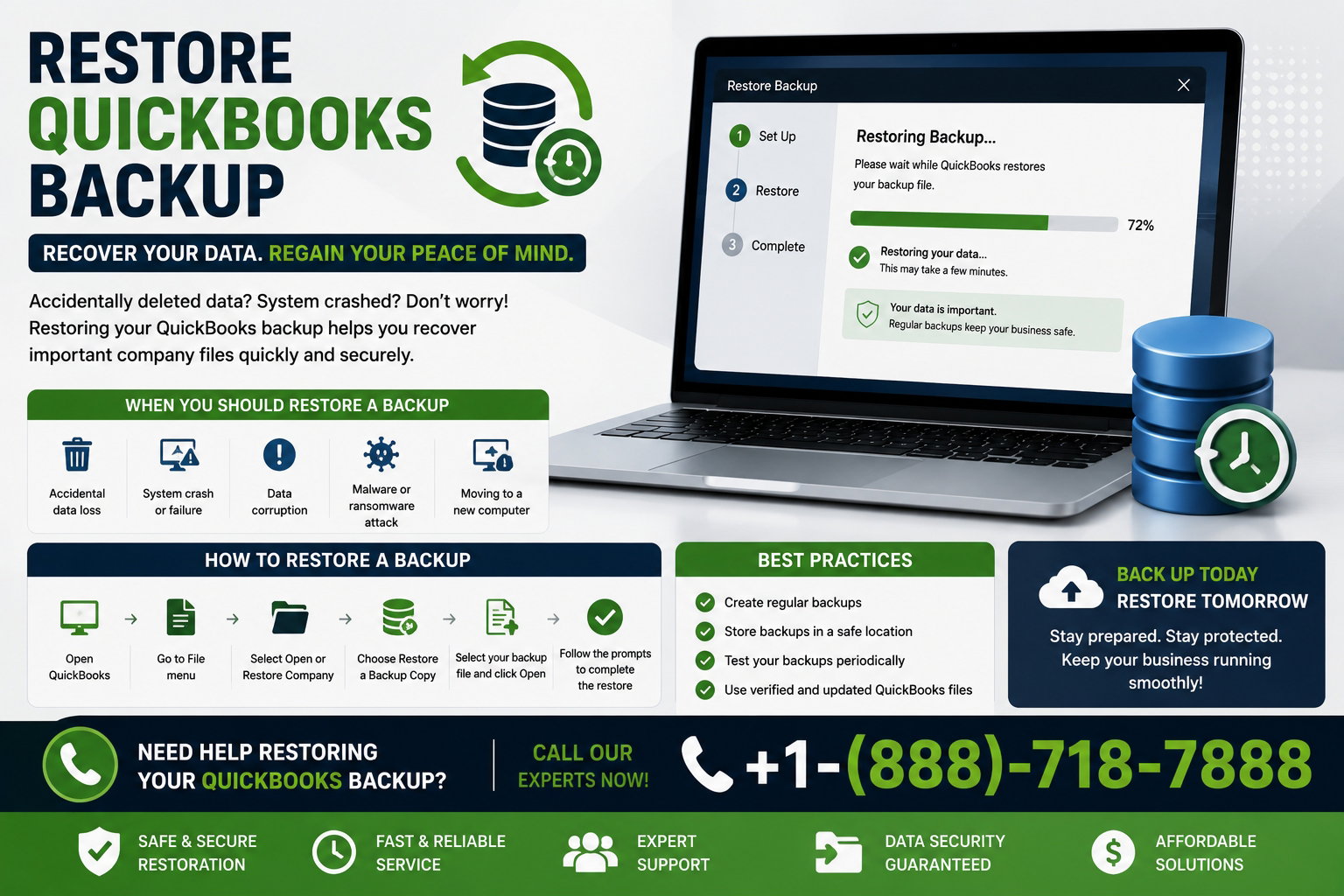
What Does "Restore QuickBooks Backup" Mean?
Restoring a QuickBooks backup means taking a saved copy of your company file and making it active again in QuickBooks . Think of it like a time machine for your financial data. You are taking a snapshot from a specific date and bringing it back to life.
Types of QuickBooks Backup Files
| File Extension | Name | Description | Best For |
|---|---|---|---|
| .QBB | QuickBooks Backup File | Full company file backup created through QuickBooks backup feature | Regular backups, full data recovery |
| .QBX | Portable Company File | Compressed, smaller version of your company file | Moving files between computers, sending to your accountant |
| .QBA | Accountant's Copy | Special file for accountant review with change tracking | Sending to your accountant while you continue working |
| .QBW.adr | Auto Data Recovery File | Automatic recovery file created by QuickBooks | Emergency recovery when no backup exists |
Why You Need to Restore a Backup
Life happens. Here are the most common reasons users need to restore QuickBooks backup files:
- Data corruption: Your company file becomes damaged and won't open
- Hard drive failure: Your computer dies and you need to move to a new one
- User error: Someone deleted critical transactions or made widespread mistakes
- Virus or malware: Your file becomes infected or encrypted
- Software issues: QuickBooks updates or crashes corrupt your active file
- Audit or review: You need to go back to a specific point in time
Important: Restore vs. Open
You cannot open a .QBB or .QBX file like a regular .QBW file. Backup files must be restored first. The restore process converts the backup into a working company file that QuickBooks can open and use .
Before You Restore: Preparation Steps
Taking a few minutes to prepare can save you from making the situation worse.
Step 1: Locate Your Backup Files
Before starting, find where your backup files are stored. Common locations include:
| Backup Type | Typical Location |
|---|---|
| Local backup | C:\Users\[YourName]\Documents\Intuit\QuickBooks\Backup |
| Portable file | Wherever you saved it (Desktop, Downloads, USB drive) |
| External drive | D:\QuickBooks Backups\ or similar |
| Network location | \\Server\QuickBooks\Backups\ |
Step 2: Verify You Have the Right Backup
Check the Date Modified column in File Explorer. The most recent backup is usually the one you want. If you are restoring because of an error, you may want an older backup from before the error started.
Step 3: Create a Copy of Your Current File (If Accessible)
If your current company file still opens (even with errors), create a backup of it before restoring. This preserves the current state in case you need to try a different recovery method.
Step 4: Ensure Sufficient Disk Space
Restoring a backup requires free space on your hard drive. QuickBooks needs at least 2-3 times the size of the backup file. Check your available space before starting.
Step 5: Close QuickBooks (For Portable File Restoration)
For .QBX (portable) files, you must close any open company file before restoring. For .QBB (regular backup) files, QuickBooks will prompt you to close the current file automatically .
Method 1: Restore a Regular Backup (.QBB File)
This is the most common restore method. A .QBB file is a complete backup of your company file created through QuickBooks' built-in backup feature.
Step-by-Step Instructions
Step 1: Open QuickBooks Desktop
- Open QuickBooks Desktop
- You can stay on the "No Company Open" screen
Step 2: Navigate to Restore Option
- Go to File → Open or Restore Company
- Select Restore a backup copy
- Click Next
Step 3: Select Backup Type
- Select Local Backup (for backups on your computer, USB drive, or external hard drive)
- Click Next
Note: If you use QuickBooks Online Backup, select Online Backup instead and follow your provider's prompts .Step 4: Locate Your Backup File
- Click Next after reading the instructions
- Browse to the location of your
.QBBbackup file - Select the file and click Open
Step 5: Choose Restore Location
- QuickBooks will ask where to save the restored company file
- Choose a location (the default is usually fine)
- Pro Tip: Use a simple path like
C:\QBData\to avoid future "file not found" issues
Step 6: Confirm and Restore
- Click Save
- If a file with the same name already exists, QuickBooks will ask if you want to replace it
- Click Yes to replace or No to choose a different name
- Wait for the restore to complete
- Click OK when finished
Step 7: Open the Restored File
- The restored file will open automatically after restoration
- If not, go to File → Open Previous Company and select the restored file
Method 2: Restore a Portable Company File (.QBX)
A portable company file (.QBX) is smaller than a regular backup and is often used to move files between computers or send to accountants .
Why Use Portable Files
Portable files are compressed and easier to transfer. However, they do not contain all the same data as a regular backup (some audit trail information may be compressed). Always use a regular .QBB backup for full disaster recovery.
Step-by-Step Instructions
Step 1: Close Any Open Company File
- Before restoring a portable file, you must close any open company file
- Go to File → Close Company/Logoff
Step 2: Navigate to Restore Option
- Go to File → Open or Restore Company
- Select Restore a portable company file (.QBX)
- Click Next
Step 3: Locate Your Portable File
- Browse to the location of your
.QBXfile - Select the file and click Open
Step 4: Choose Restore Location
- Choose where to save the restored
.QBWfile - Enter a name for the restored file (you can keep the same name)
- Click Save
Step 5: Wait for Restoration
- QuickBooks will convert the portable file back to a full company file
- This may take several minutes for large files
- Click OK when finished
Step 6: Open the Restored File
- The restored file should open automatically
- If not, go to File → Open Previous Company and select it
Method 3: Use Auto Data Recovery (.QBW.adr)
If you do not have a backup file, QuickBooks may have created an Auto Data Recovery (ADR) file automatically. These files are saved in the same folder as your original company file with the extension .QBW.adr .
When to Use ADR Files
- You have no regular backup (
.QBB) or portable file (.QBX) - Your original company file is corrupted or missing
- You need to recover as much data as possible
Step-by-Step Instructions
Step 1: Locate the ADR File
- Navigate to the folder where your original company file was stored
- Look for a file with the same name but ending in
.QBW.adr - Example:
MyCompany.QBW.adr
Step 2: Copy the ADR File
- Copy the
.QBW.adrfile to a new location (like your Desktop) - Do not work on the original ADR file—always make a copy
Step 3: Rename the File
- Right-click the copied file and select Rename
- Remove
.adrfrom the end of the filename - The file should now end with
.QBW
Step 4: Open in QuickBooks
- Open QuickBooks Desktop
- Go to File → Open or Restore Company
- Select Open a company file
- Browse to your renamed file and open it
Note: ADR files may not contain the very latest transactions, but they will have most of your data .
Common Restore Errors and How to Fix Them
Even when you follow the steps correctly, restore operations can fail. Here are the most common errors and their solutions.
Error: "Restore Failed" or "Error Restoring Backup"
What it means: QuickBooks cannot complete the restore operation. This is often due to file corruption, incorrect file format, network issues, or insufficient disk space .How to fix it:
- Check disk space: Ensure you have at least 2-3 times the backup file size free on your hard drive
- Try a different restore location: Save the restored file to a different folder or drive
- Move the backup file locally: If the backup is on a network drive or USB drive, copy it to your local hard drive first, then restore from there
- Rename the backup file: Remove any special characters (spaces, hyphens, etc.) from the filename
- Use QuickBooks File Doctor: Run the File Doctor from QuickBooks Tool Hub to repair the backup file before restoring
Error: QuickBooks Cannot Open the Backup File
What it means: The backup file may be corrupted, from a newer version of QuickBooks, or is not a valid QuickBooks backup .How to fix it:
- Verify the file extension: Ensure the file ends with
.QBB(regular backup) or.QBX(portable file) - Check QuickBooks version: You cannot restore a backup from a newer version of QuickBooks into an older version
- Try an older backup: If one backup is corrupted, try restoring from an earlier backup
- Use a data recovery tool: If the file is severely corrupted, professional data recovery may be needed
Error: 6000 Series Errors During Restore
Error codes like: -6000, -80, -6000, -83, -6000, -77 .What it means: QuickBooks cannot access or read the backup file. This often points to file permission issues or data damage .How to fix it :
- Copy the backup file to your local drive: If the backup is on a network or external drive, copy it to your local hard drive first
- Check file permissions: Ensure your Windows user account has Full Control permissions on the folder containing the backup
- Rename supporting files: If restoring a portable file, delete any existing
.NDor.TLGfiles with the same name in the target folder - Run QuickBooks File Doctor: Use the File Doctor tool to diagnose and repair the backup file
Error: 6123, 0 During Restore
What it means: Connection to the company file was lost during restore. This can happen with network backups or large files .How to fix it :
- Move the backup locally: Copy the backup to your local hard drive before restoring
- Disable antivirus temporarily: Your antivirus may be interfering with the restore
- Create a new Windows user account: Sometimes a corrupted user profile causes restore issues
- Repair QuickBooks installation: Run the QuickBooks Install Diagnostic Tool from Tool Hub
Error: "The Backup File is from a Newer Version of QuickBooks"
What it means: You are trying to restore a backup created with a newer version of QuickBooks than what you have installed .How to fix it:
- Update your QuickBooks: Install the latest updates for your version
- Upgrade to the newer version: Purchase and install the newer version of QuickBooks
- Use an older backup: Restore a backup from before you upgraded versions
How to Use QuickBooks Tool Hub for Restore Errors
The QuickBooks Tool Hub is your best friend when restore operations fail. It contains tools specifically designed to diagnose and repair backup and restore issues.
Step-by-Step Instructions
Step 1: Download and Install QuickBooks Tool Hub 1.6.0.8
- Close QuickBooks completely
- Go to the official Intuit website and download the QuickBooks Tool Hub
- Install the Tool Hub by double-clicking the downloaded file
- Open the Tool Hub from your desktop
Step 2: Run QuickBooks File Doctor
- In the Tool Hub, select Company File Issues
- Click Run QuickBooks File Doctor. It may take up to one minute to open
- Browse to your backup file (
.QBBor.QBX) - Choose Check your file
- Click Continue
- Wait for the scan to complete (5-20 minutes)
Step 3: Run QuickBooks Install Diagnostic Tool (If Needed)
- In the Tool Hub, select Installation Issues
- Click QuickBooks Install Diagnostic Tool
- Wait 20 minutes for the tool to complete
- Restart your computer
Step 4: Try Restoring Again
- After running the tools, attempt the restore again
How to Prevent Backup and Restore Problems
Once you have successfully restored your data, take these steps to prevent future issues.
1. Create Regular Backups
Set up scheduled backups in QuickBooks:
- Go to File → Back Up Company → Schedule Backup
- Choose daily or weekly backups
- Select a backup location (external drive or cloud storage recommended)
2. Verify Your Backups
Periodically test your backups by restoring them to a different location. A backup you have never tested is not really a backup.
3. Keep Multiple Backup Copies
- Keep the last 5-7 backups, not just the most recent one
- Store backups in at least two locations (local drive + external drive or cloud)
4. Do NOT Store Backups on the Same Drive
Never store your backup on the same physical drive as your active company file. If the drive fails, you lose both.
5. Use the .QBB Format for Full Backups
Use regular .QBB backups for disaster recovery, not portable .QBX files. Portable files are compressed and do not retain all audit trail information.
6. Keep QuickBooks Updated
Regular updates include improvements to backup and restore reliability:
- Go to Help → Update QuickBooks Desktop
- Click Update Now → Get Updates
Frequently Asked Questions (FAQs)
Q1: What is the difference between .QBB and .QBX files?
A: A .QBB file is a full backup of your company file. A .QBX file is a portable company file—a compressed version that takes up less space. Portable files do not retain all audit trail information, so always use .QBB for disaster recovery .
Q2: How do I restore a backup from a USB drive?
A: Connect the USB drive, then follow the regular restore steps (Method 1). QuickBooks can restore directly from the USB drive, but for large files, copy the backup to your local hard drive first for faster restore.
Q3: Why is my restore taking so long?
A: Restore time depends on file size. Large files (over 500 MB) can take 20-45 minutes . If the progress bar has not moved for 15+ minutes, the restore may be frozen.
Q4: Can I restore a backup from a newer version of QuickBooks?
A: No. You cannot restore a backup from QuickBooks 2024 into QuickBooks 2023 . You need to either update your QuickBooks or install the newer version .
Q5: What should I do if my backup file is corrupted?
A: Try using an older backup first. If none work, run the QuickBooks File Doctor to repair the backup file. If that fails, professional data recovery may be needed .
Q6: Will restoring a backup delete my current data?
A: Yes. Restoring a backup replaces your current company file with the data from the backup . If you want to keep the current file, rename it before restoring or choose a different restore location.
Q7: How often should I back up QuickBooks?
A: Daily backups are recommended for active businesses. At minimum, back up weekly. Also back up before any major operation (year-end close, updates, data rebuilds).
Q8: Where does QuickBooks store automatic backups?
A: QuickBooks automatic backups are typically saved in C:\Users\[YourName]\Documents\Intuit\QuickBooks\Backup . You can change this location in the backup settings.
Q9: Can I restore a backup if I don't have QuickBooks installed?
A: No. QuickBooks Desktop must be installed to restore a QuickBooks backup file . You cannot open a .QBB or .QBX file with any other program.
Q10: How do I restore an accountant's copy (.QBA)?
A: Accountant's copies require a different process. From your accountant, select File → Accountant's Copy → Import Accountant's Changes and follow the prompts .
Quick Reference: Backup vs. Portable vs. ADR
| Feature | .QBB (Backup) | .QBX (Portable) | .QBW.adr (ADR) |
|---|---|---|---|
| Full data retention | ✅ Yes | ❌ Partial | ✅ Yes (mostly) |
| Smaller file size | ❌ No | ✅ Yes | ❌ No |
| Best for disaster recovery | ✅ Yes | ❌ No | ⚠️ Emergency only |
| Created automatically | ❌ No | ❌ No | ✅ Yes |
| Can email easily | ❌ No (large) | ✅ Yes | ❌ No |
| Restore time | Moderate | Fast | Moderate |
When to Call for Technical Help
You have tried everything. You attempted to restore your backup using the correct method. You ran QuickBooks File Doctor. You checked disk space. You tried different restore locations. The restore still fails, or you get the same error every time.At this point, the issue is likely one of three things:
- Severe backup file corruption that consumer tools cannot repair
- A failing hard drive causing corruption during the restore
- A Windows system issue blocking the restore process
For direct assistance with restoring QuickBooks backups, call: 1-888-718-7888.When you call, have this information ready:
- Your QuickBooks version and year
- The backup file type (.QBB, .QBX, or .QBA)
- The exact error message (if any)
- The file size of your backup
- A list of solutions you have already tried from this guide
Tell the representative: "I am trying to restore a QuickBooks backup file. I have already tried running QuickBooks File Doctor and checking disk space. I need help with [describe the error]."
Final Thoughts: Your Backup Is Your Business Lifeline
The ability to restore QuickBooks backup files is one of the most important skills for any QuickBooks user. Your financial data is the lifeblood of your business. A working backup and a working restore process are your safety net when disaster strikes.Remember the key points:
- Regular backups are essential (daily is best)
- Test your backups by restoring them occasionally
- Keep multiple copies in different locations
- Know the difference between .QBB (full backup) and .QBX (portable)
- Use QuickBooks Tool Hub when restore operations fail
Do not wait for a disaster to learn how to restore a backup. Practice the process today. Keep your backups current. And when something goes wrong, work through the solutions in this guide methodically.Your business runs on QuickBooks. Protect it with good backups and reliable restores.
